
 Español
 Pусский
 Indonesia
 Tiếng Việt

Automated Continuous Casting Line
Automated Continuous Casting Line An automated continuous casting line is a highly efficient and advanced manufacturing system used primarily in the metal industry to produce long, uniform metal products such as billets, blooms, and slabs. This process involves the continuous pouring of molten metal into a water-cooled mold, solidifying it into a semi-finished shape, which is then further processed through cutting, rolling, or extrusion. Automation ensures precision, consistency, and improved productivity while reducing human intervention and operational costs. Key Components of an Automated Continuous Casting Line 1. Melting and Pouring System The process begins with the melting of raw metal in a furnace. Once the desired temperature and composition are achieved, the molten metal is transferred to a tundish, which regulates the flow into the mold. Automated ladles and sensors ensure precise pouring to maintain quality. 2. Water-Cooled Mold The molten metal enters a water-cooled copper mold, where it begins to solidify at the edges while remaining liquid at the core. Oscillation mechanisms prevent sticking and ensure smooth withdrawal. 3. Secondary Cooling Zone After exiting the mold, the semi-solidified metal passes through a series of water sprays or air mist systems to further cool and solidify it uniformly. 4. Withdrawal and Straightening Units Pinch rolls or withdrawal machines pull the solidified strand at a controlled speed. If necessary, a straightening device corrects any deformities before cutting. 5. Cutting System Automated torches or shears cut the continuous strand into predetermined lengths based on downstream requirements. Sensors ensure accurate measurements. 6. Handling and Stacking The cut pieces are conveyed to cooling beds or directly to storage. Robotic arms or automated stacking systems organize the final products for further processing or shipment. Advantages of Automation - Consistency & Quality: Automated controls minimize defects like cracks, porosity, or uneven cooling. - Efficiency: Continuous operation reduces downtime and increases output. - Safety: Reduced manual handling lowers workplace hazards. - Cost-Effectiveness: Energy and labor savings improve overall profitability. Applications Automated continuous casting lines are widely used in steel, aluminum, and copper production, supplying materials for construction, automotive, and machinery industries. By integrating advanced sensors, real-time monitoring, and AI-driven adjustments, modern automated continuous casting lines represent the future of metal manufacturing, delivering high precision and sustainability.
Products
Category:
-
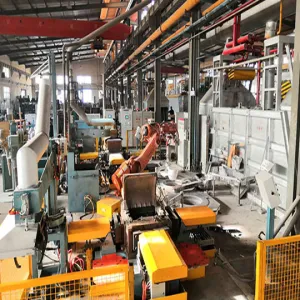
Continuous Casting Automated Production Line
Category: Automatic Casting Production LineBrowse number: 30Number:Release time: 2025-12-22 10:31:09The Continuous Casting Automated Production Line is engineered to deliver high-efficiency, precise, and consistent metal casting for industrial applications. Integrating automated mold handling, controlled pouring, and real-time monitoring, it ensures superior dimensional accuracy and reduced defects. Suitable for steel, aluminum, and copper alloys, this production line enhances throughput while minimizing material waste. Advanced sensors and intelligent control systems optimize solidification, cooling, and quality inspection processes, making it ideal for automotive, aerospace, and heavy machinery manufacturing. With energy-efficient operation and reliable performance, this automated casting solution streamlines production workflows, improves yield, and supports high-volume, precision-driven industrial requirements.
News
Category:
No search results found!
Case
Category:
No search results found!
Video
Category:
No search results found!
Download
Category:
No search results found!
Job
Category:
No search results found!
Featured Products
No search results found!



 Phone
Phone