
 Español
 Pусский
 Indonesia
 Tiếng Việt

High Precision Metal Casting Line
High Precision Metal Casting Line A high-precision metal casting line is an advanced manufacturing system designed to produce complex metal components with exceptional dimensional accuracy, surface finish, and material integrity. This process is widely used in industries such as aerospace, automotive, medical devices, and energy, where tight tolerances and high-performance materials are critical. Key Components of the Casting Line 1. Melting and Alloying System The process begins with melting high-quality raw materials in induction or electric arc furnaces. Precise temperature control ensures uniform alloy composition, minimizing impurities and defects. Automated dosing systems add alloying elements to achieve desired mechanical properties. 2. Mold Preparation High-precision molds are typically made from ceramic, sand, or investment materials, depending on the casting method (e.g., investment casting, die casting, or sand casting). Advanced 3D printing or CNC machining ensures mold accuracy, enabling intricate geometries and fine details. 3. Casting Process Molten metal is poured, injected, or vacuum-sucked into molds with controlled speed and pressure to prevent turbulence and oxidation. In investment casting, the lost-wax technique is used for ultra-fine details, while die casting employs high-pressure injection for rapid production. 4. Solidification and Cooling Controlled cooling rates prevent internal stresses and shrinkage defects. Some systems use directional solidification or vacuum-assisted cooling to enhance metallurgical properties, particularly for superalloys and titanium components. 5. Post-Processing After demolding, castings undergo precision machining, heat treatment, and surface finishing (e.g., grinding, polishing, or coating) to meet final specifications. Non-destructive testing (X-ray, ultrasonic, or CT scanning) ensures defect-free parts. Advantages - Tight Tolerances: Achieves dimensional accuracies within ±0.1mm or better. - Material Versatility: Compatible with steel, aluminum, titanium, and high-temperature alloys. - Efficiency: Automated systems reduce labor costs and cycle times. - Sustainability: Closed-loop cooling and recycling minimize material waste. Applications - Aerospace: Turbine blades, engine housings. - Medical: Implants, surgical instruments. - Automotive: Lightweight structural parts, powertrain components. By integrating advanced process control, automation, and quality assurance, a high-precision metal casting line delivers superior performance, reliability, and cost-efficiency for critical industrial applications.
Products
Category:
-
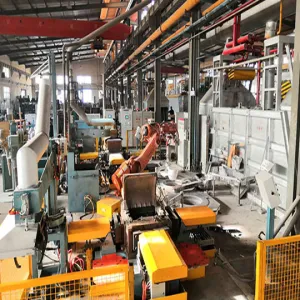
Continuous Casting Automated Production Line
Category: Automatic Casting Production LineBrowse number: 30Number:Release time: 2025-12-22 10:31:09The Continuous Casting Automated Production Line is engineered to deliver high-efficiency, precise, and consistent metal casting for industrial applications. Integrating automated mold handling, controlled pouring, and real-time monitoring, it ensures superior dimensional accuracy and reduced defects. Suitable for steel, aluminum, and copper alloys, this production line enhances throughput while minimizing material waste. Advanced sensors and intelligent control systems optimize solidification, cooling, and quality inspection processes, making it ideal for automotive, aerospace, and heavy machinery manufacturing. With energy-efficient operation and reliable performance, this automated casting solution streamlines production workflows, improves yield, and supports high-volume, precision-driven industrial requirements.
News
Category:
-
[Industry News]Truss Manipulator Remote Monitoring Features
2025-12-28 08:47:34
Case
Category:
No search results found!
Video
Category:
No search results found!
Download
Category:
No search results found!
Job
Category:
No search results found!
Featured Products
No search results found!



 Phone
Phone